

Welcome to RemoLabs! This research series presents insights derived from anonymized customer data, utilizing RemoFirst's Employer of Record platform, as well as surveys and third-party market research. We then share our findings to help you hire smarter and navigate global expansion.
Latin America is high on the wish list for global hiring, but often low on actual execution.
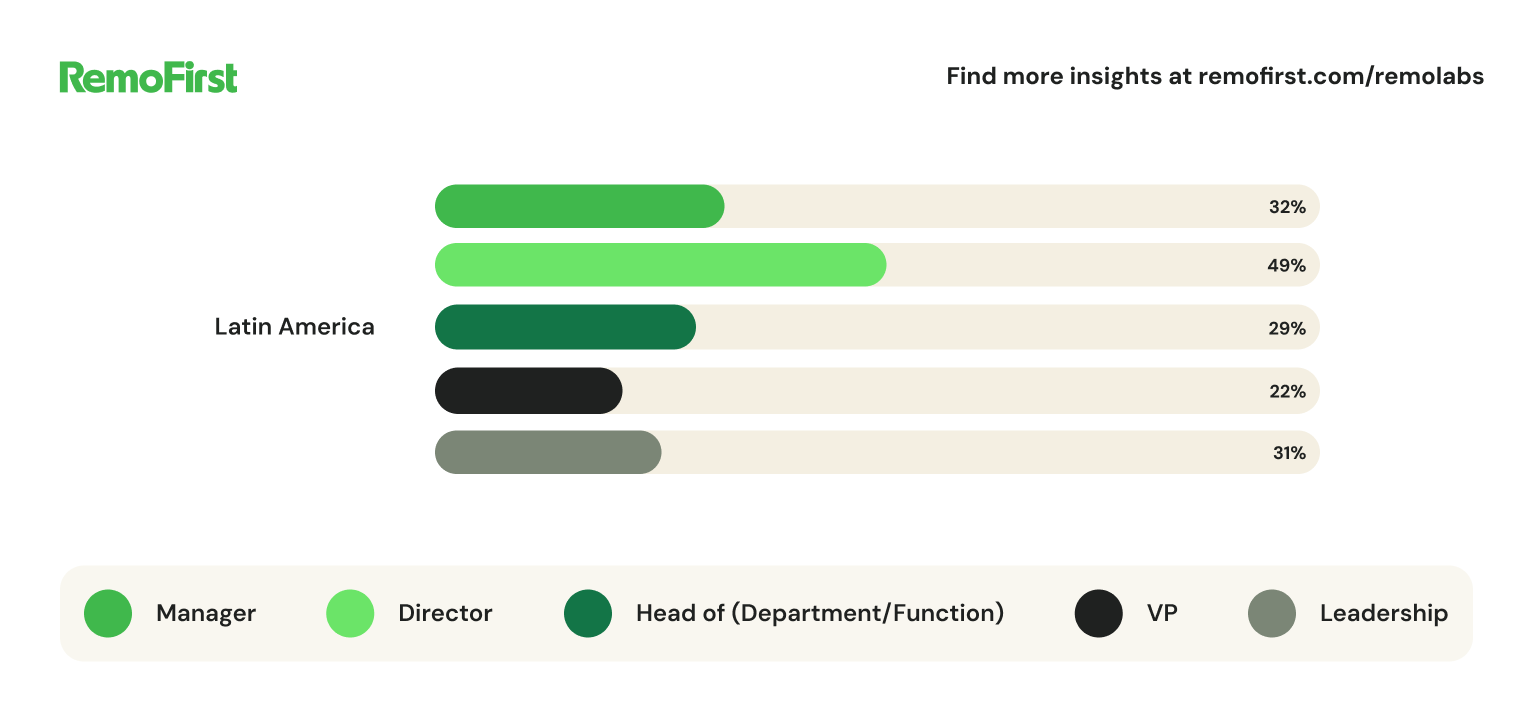
While nearly half (49%) of hiring managers are eager to tap into the region’s talent, only 22% of directors and 31% of executives share that enthusiasm.
This disconnect isn’t just a difference in opinion, it’s a missed opportunity.
The people closest to the hiring process are often the first to spot where the best talent is. But without leadership alignment, that insight can stall out in red tape, risk aversion, or outdated market assumptions.
In this edition of RemoLabs, I’ll explore why Latin America is becoming one of the most attractive regions for global hiring and how companies can bridge the internal gap to act on it. Some of these insights come from our recent research report, The State of International Hiring.
The Rising Appeal of Latin America
Proximity to U.S. Time Zones
Most of Latin America sits within 0–3 hours of U.S. time zones, which is a huge operational advantage compared to regions that are 6–10 hours away.
Recent analyses of nearshore trends show U.S. companies increasingly prioritizing “time zone fit” when choosing where to build remote teams, with LATAM repeatedly cited as the preferred nearshore hub not only in this past year but beyond.
In practical terms, that means:
- Real-time collaboration across engineering, product, and GTM teams
- Fewer after-hours meetings and scheduling gymnastics
- Easier integration of remote hires into core teams (not “the offshore team”)
For hiring managers who care about productivity and culture, this is one of the most compelling, day-to-day reasons to push for LATAM hiring.
Strong Technical and Bilingual Talent Pools
The tech talent story in Latin America keeps getting stronger:
- Recent estimates put the regional tech talent pool at around 2 million professionals, with software developers making up a large share.
- According to this data, Brazil is home to roughly 750,000 software developers, Mexico to about 560,000, with Argentina and Colombia adding another 235,000 between them — giving companies real depth at scale.
- A 2025 report projects the Latin America SaaS market at about $22 billion in 2025, with growth expected to reach more than $72 billion by 2034, driven by increasing cloud and enterprise software adoption across the region.
- On the demand side, the U.S. alone is projected to face a shortage of nearly 1.2 million software engineers by 2026, according to Bureau of Labor Statistics data cited in recent analyses.
Put simply:
- Demand in core markets (like the U.S.) is on the rise heading into 2026.
- Supply in LATAM is deep, increasingly senior-level, and cost-competitive.
- English proficiency and familiarity with U.S. business norms are steadily improving, especially in key tech hubs.
No wonder managers experiencing this daily hiring squeeze are eager to look south.
Growing Startup Ecosystems and Digital Infrastructure
The macro picture has also shifted in Latin America’s favor:
- Investment in Latin American startups grew 26% in 2024 vs. 2023, with studies projecting additional growth through 2025 and beyond as capital concentrates in stronger, more mature companies.
- Economic outlooks for 2026 project continued growth across the region, despite political noise and trade tensions, with structural reforms and digitalization named as key drivers.
- The regional outsourcing market is expected to generate almost $20 billion in 2025, with an estimated 9% compound annual growth rate over the next 5 years — meaning demand for LATAM-based service and tech teams will keep expanding into the early 2030s.
All of this sits on top of rapid improvements in connectivity, fintech access, and startup density. The ecosystem isn’t just “up-and-coming” anymore; it’s entering a sustained growth phase that will carry into 2026 and beyond.
What the Data Shows
From RemoFirst’s recent survey of global HR stakeholders:
- 49% of HR managers say they would like to hire in Latin America.
- Only 22% of directors and 31% of executives share that enthusiasm.
Interpreted simply:
- The people closest to candidates (HR and hiring managers) see Latin America as a high-potential, underused talent market.
- Leadership is moving more slowly, either because of perceived risk, competing priorities, or lack of clarity on the “how.”
That misalignment has real cost:
- Roles stay open longer in saturated talent markets.
- Competitors who already embraced LATAM hiring gain first-mover advantage — better candidates, stronger employer brand awareness in the region, and more data on what works.
HR teams feel the strain of being asked to “do more with less” while attractive markets remain underused.
In a world where global IT and software spending is projected to keep growing into 2026 on the back of AI and digital transformation investments, delaying access to efficient talent pools is not a neutral decision — it’s falling behind.
What’s Holding Leadership Back?
If the data and market signals are so positive, why is leadership still hesitant?
Perceptions of Risk or Instability
Executives often have to think in terms of macro risk:
- Currency volatility
- Political shifts
- Policy and regulatory unpredictability
Recent outlooks acknowledge these risks but still project regional growth in 2026, suggesting the opportunity is strong enough to outweigh the noise when approached thoughtfully.
The gap is less about whether LATAM is viable and more about whether leaders feel they have the right structure to manage that risk.
Concerns About Compliance Complexity
Latin America’s labor and tax environments differ widely between countries. Leadership worries about:
- Misclassification of contractors
- Incorrect handling of severance, social contributions, or benefits
- Local penalties, blocked accounts, or reputational damage for missteps
From the C-suite perspective, “Let’s hire in Brazil and Mexico” can sound like “Let’s add two new regulatory regimes to our risk profile.”
Lack of Clear, Localized Hiring Insights
Even when HR is enthusiastic, leadership often doesn’t see:
- Side-by-side comparisons of total cost of employment (salary + employer taxes + benefits) vs. U.S. or European equivalents
- Data on time-to-hire, seniority levels, or retention for LATAM roles
- A clear plan for how to hire compliantly (local entity vs. Employer of Record vs. contractors)
So the conversation stalls at “This sounds interesting” instead of “This is a de-risked, data-backed expansion plan.”
How to Bridge the Gap
The key is to turn manager enthusiasm into a business case that leadership can comfortably approve — whether your company is based in Berlin, Singapore, Toronto, Nairobi, or São Paulo.
Open Dialogue Between HR, Hiring Managers, and Leadership
Move from general enthusiasm to a structured proposal:
1. Define the problem
Anchor the conversation in a concrete pain point, for example:
- “We’re consistently losing senior backend candidates in our home market due to compensation and time-to-hire.”
- “Our support team can’t cover the growing customer base across time zones without burning people out.”
- “We need to scale product delivery faster, but local talent pipelines are tapped out.”
2. Propose specific markets
Instead of “Let’s hire in LATAM,” be precise:
- Suggest 1–2 target countries (for example, Mexico and Colombia for engineering and support, Brazil for data and product roles, or Argentina for design and analytics).
- Connect the choice to clear advantages: talent depth, seniority, language skills, time zone fit with your existing hubs, and long-term scalability.
This makes it easier for leadership to see why these countries, not just why the region.
3. Bring numbers
Leadership teams anywhere in the world make decisions on data, not vibes. Include:
- Typical salary bands and total cost of employment (salary + taxes + contributions + benefits) compared with your current hiring markets.
- Expected time-to-hire based on local recruiting partners, market benchmarks, or your own tests.
- The operational upside: faster product delivery, extended customer coverage hours, or reduced turnover compared with your current approach.
4. Show risk controls
Make it clear that this is not an all-or-nothing bet:
- Use an Employer of Record (EOR) instead of opening local entities in year one.
- Start with a pilot number of hires and defined success metrics (time-to-hire, performance, retention, cost per hire).
- Set a review point (for example, after 6 or 12 months) to decide whether to scale, pause, or adjust.
This reframes LATAM hiring from “HR preference” to a measured, reversible experiment that fits into your global talent strategy.
Start With Small Pilot Hires or Contractor Roles
Executives are almost always more comfortable with a pilot than a full regional rollout. For example:
- 3–5 strategic roles (senior engineers, key customer-facing positions, or critical operations roles) in one or two LATAM countries.
- A 6–12 month test window with agreed KPIs:
- Cost per hire and total cost of employment
- Performance ratings and delivery outcomes
- Retention and engagement
- Team satisfaction and collaboration across time zones
You can also phase your approach:
- Start with contractors for project-based or non-core work to validate collaboration, communication, and quality.
- Convert top performers into full-time roles through an EOR once the business case is clear and you know which markets work best.
This gives leadership confidence that they can scale up what works and discontinue what doesn’t, without being locked into local entities, long-term leases, or complex legal setups.
It also gives HR and hiring managers a practical path to prove that LATAM talent can support global teams, no matter where “headquarters” is.
Use an Employer of Record (EOR) to Reduce Compliance Risk
For many companies, the turning point is realizing they don’t need to become experts in every country’s labor laws.
An EOR in Latin America:
- Acts as the legal employer in-country
- Handles contracts, payroll, tax withholding, benefits, and compliance
- Lets your team manage the day-to-day work while they manage the regulatory side
For leadership, this shifts the question from “Do we want to take on Brazil’s labor law?” to “Do we want to run a low-risk pilot with a partner that already does this across the region?”
Our Perspective
At RemoFirst, we see the 49% vs. 22% vs. 31% split as a signal:
- HR and hiring managers are already looking at 2026 and beyond, trying to secure flexible, high-quality talent pipelines.
- Leadership teams are open, but need clearer data, risk mitigation, and operational simplicity.
That’s exactly where a global EOR, plus local expertise, makes the difference:
- Coverage in 185+ countries, including all major LATAM markets, so you can test one country or several without spinning up local entities.
- Flat, transparent pricing that makes it easy for finance to model scenarios and compare LATAM roles with other regions.
- Fast, compliant onboarding backed by local partners who’ve run payroll at scale for decades, so you don’t spend 2026 reinventing what already exists.
For companies of all sizes — from seed-stage startups to mid-market and global orgs — LATAM is no longer a “nice to explore someday” region. With the right structure, it’s a practical way to:
- Fill critical roles faster
- Reduce hiring costs without trading off on quality
- Diversify your workforce across resilient, growing markets
If your HR team is already raising Latin America as a priority, the numbers now back them up not just for 2025, but for the rest of the decade.
About This Data
Our data is anonymized from customer insights and trends as well as surveyed from hundreds of HR and People Ops leaders globally. While this does not include millions of data points, this is collected among thousands of companies globally who are finding and open to talent based in countries around the world.