




Welcome to RemoLabs! This research series presents insights derived from anonymized customer data, utilizing RemoFirst's Employer of Record platform, as well as surveys and third-party market research. We then share our findings to help you hire smarter and navigate global expansion.
For years, global hiring has had a bit of a reputation problem.
Ask most HR leaders or founders what comes to mind, and you’ll hear the same concerns. It’s slow. It’s complex. It’s full of compliance risks. And while some of those reasons were valid in the past, the reality has changed.
Today, the data tells a very different story.
According to our latest global hiring survey, companies are not just succeeding with global hiring, they’re doing it faster than ever. In fact, many are seeing better speed and performance outcomes than they do in their home markets.
Let’s take a closer look at what’s really happening.
Global Roles are Being Filled Faster than HQ Roles
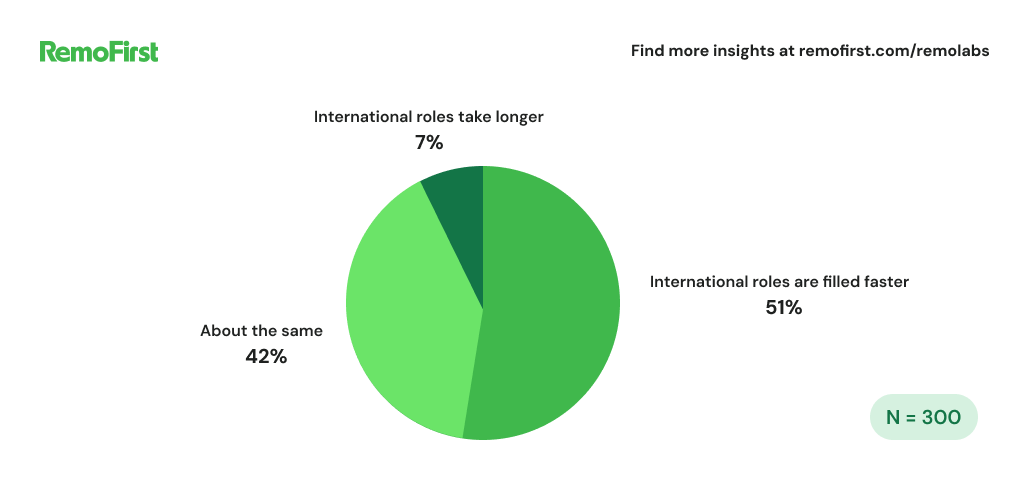
One of the most surprising findings from the survey is just how quickly companies are hiring people for international roles.
51% of respondents said that international roles are filled faster than roles at headquarters
That runs directly counter to the traditional assumption that hiring across borders slows everything down.
So what’s driving this shift?
A Larger, More Accessible Talent Pool
When companies hire locally, they are limited by geography. Even in major cities, the pool of qualified candidates can be smaller than expected, especially for specialized roles.
Global hiring removes that constraint entirely.
Instead of competing for the same candidates as every other company in your city, you gain access to talent across dozens of countries. That dramatically increases your chances of finding the right fit quickly.
This aligns with broader labor market data.
According to LinkedIn’s Global Talent Trends research, talent shortages remain one of the biggest barriers to hiring, particularly in highly competitive markets. Expanding the search globally helps companies overcome those shortages more efficiently.
Less Competition in Saturated Markets
In many HQ locations, especially tech hubs, competition for talent is intense. Candidates often juggle multiple offers, which can slow down decision-making and extend hiring timelines.
In contrast, when you hire internationally, you’re often tapping into talent pools where there’s less competition for the same candidates.
ManpowerGroup research shows that most employers around the world are struggling to find skilled talent, especially in more developed markets. Looking internationally can help ease that pressure and make it easier to hire.
More Efficient Hiring Processes
Global hiring has also pushed companies to rethink how they hire.
Distributed teams rely more on asynchronous communication, structured interviews, clear evaluation criteria, and better HR technology. These practices remove bottlenecks that often exist in traditional hiring processes.
A report from McKinsey & Company highlights that organizations embracing remote and digital-first workflows often see improved speed and efficiency in decision-making, including hiring.
The result is a more streamlined experience for both employers and candidates.
Global Hires Ramp Up Faster Too
Hiring speed is only part of the equation. What matters just as much is how quickly new hires become productive in their new role.
Here again, the data challenges expectations.
43% of respondents said that global hires make an impact faster than local hires
This is a critical insight for growing companies. Faster ramp up times mean faster impact, quicker project delivery, and better return on their global hiring investment.
So why are international hires getting up to speed more quickly?
Remote Readiness Is Already There
Many international candidates have prior experience working remotely or with distributed teams. They are comfortable with digital tools, async communication, and managing their own time.
This reduces the learning curve significantly.
According to research from Owl Labs, remote workers tend to be more experienced with digital collaboration tools and self-management, which contributes to faster onboarding and productivity in distributed environments.
Strong Motivation and Ownership
For many global candidates, working for an international company represents a significant career opportunity. That often translates into higher levels of engagement early on.
They are motivated to learn quickly and deliver results.
A study by Gallup consistently shows that engaged employees are more productive and start delivering results faster, especially when they feel they have access to meaningful opportunities.
Better Onboarding by Design
Global hiring often forces companies to improve their onboarding processes.
When teams are distributed, you can’t rely on informal knowledge sharing. Everything needs to be documented, structured, and accessible.
According to SHRM, organizations with structured onboarding programs see faster time to productivity and higher retention rates.
While this is not exclusive to global hiring, distributed teams tend to adopt these best practices more consistently.
What This Means for Growing Teams
When you combine faster hiring with faster onboarding times, the impact is hard to ignore. Global hiring is not just a way to access talent. It’s a way to accelerate growth.
Faster Hiring Means Faster Execution
Open roles slow teams down. Projects get delayed, workloads increase, and opportunities are missed.
If you can fill roles faster, you reduce that downtime and maintain momentum.
Faster Ramp Means Quicker Return on Investment
Hiring is expensive. It takes time before a new employee starts delivering meaningful value.
When global hires get up to speed quickly, everything moves faster. Teams start seeing results sooner, which is a big advantage for startups and scaling companies.
A Competitive Advantage, Not a Workaround
For a long time, global hiring was seen as a workaround.
That mindset is changing.
Companies that embrace global hiring are building more agile, resilient teams and moving faster than competitors who are still limited by geography.
The Real Barrier Isn’t Speed
If global hiring is faster to fill roles and faster for employees to start making meaningful contributions, why does the perception of slowness still exist?
The answer is simple. Outdated assumptions.
Many companies are still operating based on how global hiring worked years ago, when compliance challenges and operational hurdles made the process more difficult.
But the infrastructure has evolved.
With the right tools and partners, companies can now hire, onboard, and pay employees across 185+ countries quickly and compliantly. What used to take months can now happen in days.
The companies seeing the biggest gains are the ones that have recognized this shift.
They are not asking whether global hiring is possible. They are asking how quickly they can scale it.
About This Data
Our data is anonymized from customer insights and trends as well as surveyed from hundreds of HR and People Ops leaders globally. While this does not include millions of data points, this is collected among thousands of companies globally who are finding and open to talent based in countries around the world.