


Hiring talent across borders has never been easier. As companies embrace remote work and hire international contractors, they gain access to specialized skills, as well as faster market expansion.
But the rise of global contractor hiring also comes with increasing scrutiny around misclassification, and misclassifying workers can lead to costly penalties, back payments, and employer brand damage.
One way to engage contractors while minimizing the risk of misclassification is by working with an Agent of Record (AOR), a third-party that helps companies manage the administrative and compliance aspects of working with contractors — without becoming their legal employer.
In this post, we’ll look at some of the best AOR services, highlighting how they help businesses compliantly hire and manage contractors across the globe.
AOR vs. EOR: What’s the Difference?
While both AORs and EORs help companies expand globally, they serve different purposes.
In simple terms:
- Use an AOR when hiring independent contractors.
- Use an EOR when hiring full-time employees internationally.
An AOR supports compliant contractor engagements. The contractor remains an independent service provider, and the AOR isn’t their legal employer. Instead, the AOR helps reduce misclassification risk, ensures locally compliant agreements are in place, and manages documentation and payments.
An EOR, on the other hand, legally employs workers on your behalf in a country where you don’t have a local entity. The EOR handles payroll, taxes, statutory benefits, employment contracts, and compliance.
Ultimately, whether you partner with an AOR or an EOR depends on the type of working relationship you need to establish. Contractors and employees are treated differently under local labor laws, and using the right model ensures you stay compliant while scaling globally.
Best Agents of Record Services Quick View
RemoFirst
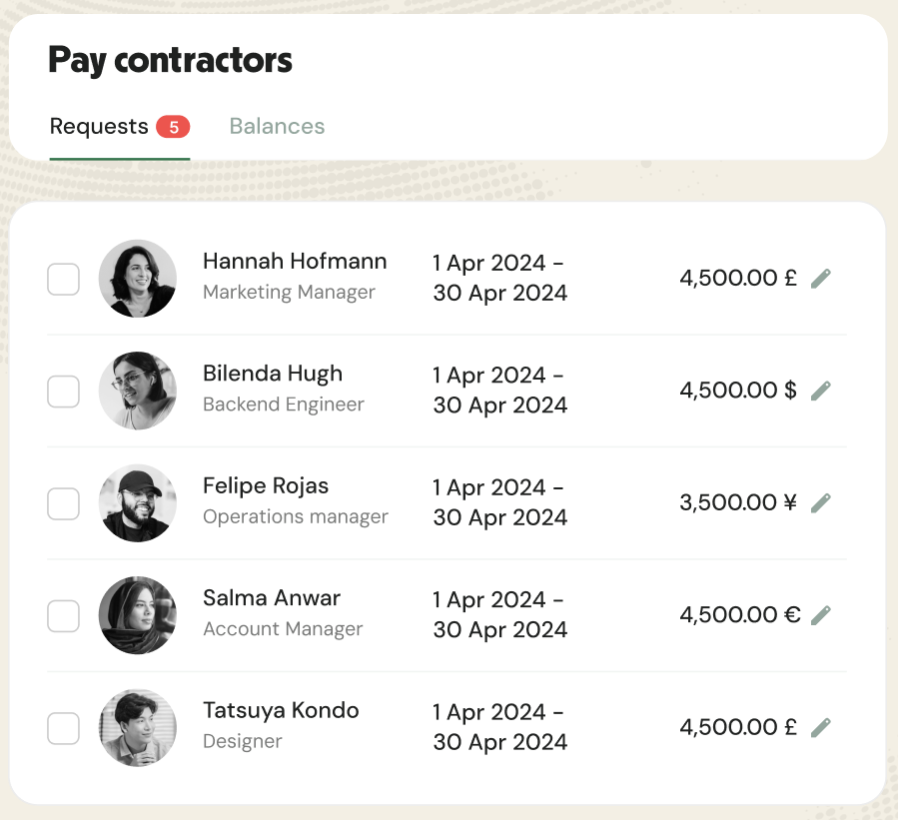
While RemoFirst is known for its EOR offerings, it’s also a top choice for businesses that need compliance coverage for contractors without enterprise-level cost. The platform combines contractor onboarding, compliant agreements, centralized documentation, and payments, and it can act as an EOR if contractors become employees. Unlike many providers, RemoFirst has transparent pricing and offers a free tier for basic contractor management.
Key Features:
- Contractor classification assessment and locally compliant agreements
- Centralized contractor payment platform supporting multiple currencies
- Documentation and audit trail in one dashboard
- Transparent pricing with a free contractor-management tier
- Integration with EOR services if contractors become employees
Best For: Startups and SMBs needing an affordable approach to global contractor hiring
Pros:
- Transparent, budget-friendly pricing of $25 per contractor/month
- Strong compliance focus with localized contract templates and risk mitigation features
Potential Limitations:
- Less suited for large enterprises with complex compliance needs
- Doesn’t yet have as many integrations as some other platforms
2. Deel
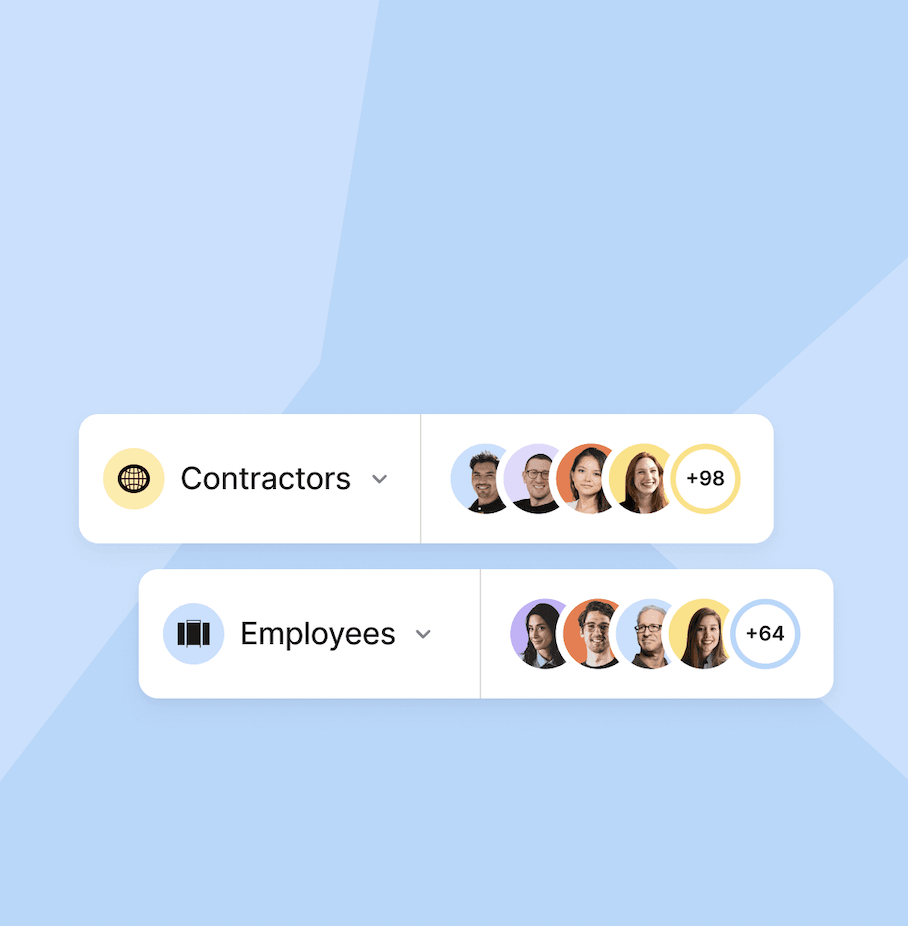
Deel combines international contractor management with AI-powered compliance tools, multi-currency payments, and a path to convert contractors into employees. While it’s primarily an EOR, it can also operate as an AOR, allowing companies to compliantly hire contractors in 130+ countries.
Key Features:
- Localized contractor agreements and tax compliance
- Automated invoicing and multi-currency payout options
- Built-in workflows for moving contractors to full-time employment with EOR services
- AI-assisted compliance and regulatory alerts
Best For: Startups and mid-sized companies scaling internationally
Pros:
- Large global network with deep compliance automation
- Robust reporting and HR tools beyond basic payments
Potential Limitations:
- Pricing is higher than some competitors, starting at $49 per contractor/month for contractor management and $325 per person/month for Contractor of Record
- Broad feature set may be overwhelming for small teams
3. Remote
Remote provides contractor compliance and payments alongside a comprehensive global HR suite. Its contractor offerings include contract creation, misclassification protection tools, and multi-currency payouts.
Key Features:
- Localized contract templates and global payout infrastructure
- Misclassification risk tools, invoice approvals, and document storage
- Standard plans with optional upgrades for more coverage
Best For: Companies that would also benefit from Remote’s broader HR and payroll capabilities
Pros:
- Strong automation for onboarding and payments
- Real-time payment visibility and recurring invoice management
Potential Limitations:
- Pricing is higher than many competitors, costing $29 per contractor/month for Remote’s Contractor Management offering, $99 per contractor/month for its Contractor Management Plus service, and starting at $325 per contractor/month for Contractor of Record services
- You may need additional Remote HR tools to unlock full functionality

4. Oyster HR
Oyster HR focuses on global contractor and employee management with an emphasis on compliance and ease of use across 180+ countries. It charges $29 per contractor/month.
Key Features:
- Automated cross-border hiring and contract generation
- Deep compliance engine with local law updates
- Integration with payroll and benefits tools
Best For: Larger companies with numerous global contractors
Pros:
- Broad geographic coverage
- Affordable pricing with first month free
Potential Limitations:
- Slightly more expensive than some competitors
- Best value is unlocked if using both contractor and Employer of Record services

5. Papaya Global
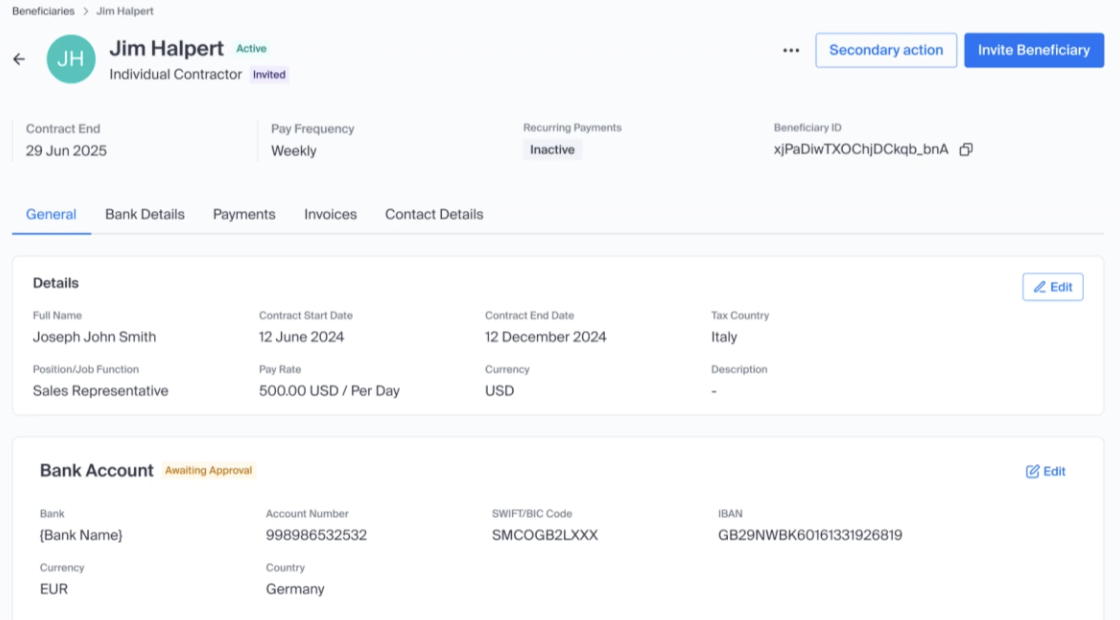
Papaya Global’s AOR services include compliance checks, tax documentation, and global payroll for workers in 160+ countries. Papaya Global also enables you to pay contractors instantly via a Banco digital wallet, which is useful for contractors in countries with unreliable banking infrastructure.
Key Features:
- Contractor compliance and misclassification protection
- Secure payment processing with multi-currency support
- Audit trails and record-keeping for risk management
Best For: Larger organizations with complex payroll needs
Pros:
- Deep compliance and administrative tooling
- Integrates well with payroll and workforce analytics
Potential Limitations:
- Pricing requires custom quotes, but starts at $5 per contractor/month for its contractor solution and $295 per contractor/month for its Contractor of Record service
- Can be overkill for small teams
6. Multiplier
Multiplier is known for competitive pricing, broad global support, and in-depth expertise in APAC markets. While often discussed in the context of EOR and payroll, its global compliance tools extend to contractor agreements and payments.
Key Features:
- Global compliance and contractor payout infrastructure
- Strong customer support for international HR operations
Best For: Companies looking for cost-effective coverage in APAC markets
Pros:
- Pricing that’s competitive compared with larger players with contractor pricing starting at $40 per contractor/month
- Designed to scale globally without heavy cost impact
Potential Limitations:
- User interface and onboarding can be less intuitive
- Cost is higher than some competitors

7. Safeguard Global
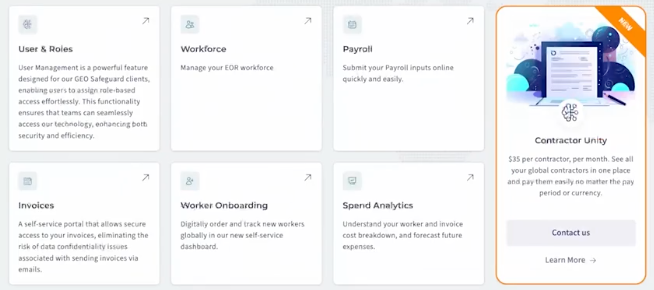
Safeguard Global provides workforce services focused on compliance-driven hiring and payroll, including contractor compliance. Pricing varies by number of contractors managed through the platform, costing $10 per person/month for 1-10 contractors, and $5 per person/month for 11+ contractors.
Key Features:
- Broad contractor and payroll compliance offerings
- Comprehensive HR and compliance support
Best For: Companies with complex compliance needs
Pros:
- Robust support and compliance infrastructure
- Flexible workforce management options
Potential Limitations:
- Pricing lacks transparency
- Enterprise focus isn’t ideal for small-team budgets
How to Choose the Right Agent of Record
Selecting the right AOR involves finding the provider that aligns with your risk profile, geographic footprint, growth plans, and HR capabilities. Here’s how to evaluate your options.
Assess Your Contractor Risk Exposure
First you need to understand your current and projected contractor needs by looking at the following:
- Number of contractors: If you’re managing only a few contractors, a lightweight and cost-effective solution may be enough. As you scale, stronger automation, controls, and reporting become more important.
- Operational footprint: Compliance complexity increases with each new jurisdiction, and the more countries you operate in, the more valuable local expertise becomes.
- Industry risk profile: Certain industries face heightened scrutiny around worker classification. If your business model relies on contractors performing core business functions, the risk of misclassification can be higher.
Understand Local Classification Standards
Not all countries treat independent contractors the same way.
Some jurisdictions are stricter than others. Countries like the United Kingdom and Germany apply more rigorous tests to determine whether a worker qualifies as an independent contractor.
It’s critical to consider reclassification risk. If a contractor is later deemed to be an employee, you could face back taxes, penalties, and potential legal disputes.
Evaluate Pricing Structure
AOR pricing differs across providers, making it essential to know what services are included in the cost.
- Flat monthly fee per contractor: This is the most common and transparent structure. You pay a fixed fee per contractor each month.
- Percentage-based models: Some providers charge a percentage of contractor compensation. While this may seem manageable initially, costs can rise significantly as contractor pay increases.
- Hidden FX or payment fees: Watch for foreign exchange markups, wire fees, and cross-border payment surcharges.
Consider Future Scalability
Your workforce model today may not look the same in a few years, so consider the following questions:
- Can you convert contractors to employees? If contractors may transition into full-time roles, choose a provider that supports contractor-to-employee conversion workflows.
- Does the platform support EOR if needed? If you anticipate hiring employees in countries where you lack entities, consider whether the AOR also offers EOR services.
- Does it integrate with payroll and HR systems? Look for integrations with HRIS, payroll, and accounting tools.
When You Need an EOR Instead of an AOR
While an AOR is ideal for hiring contractors, there are situations where an EOR is the more appropriate solution. Here are common scenarios where an EOR makes more sense:
When a Contractor Should Actually Be an Employee
If the nature of the role doesn’t meet local contractor standards, engaging the worker as a contractor could create misclassification risk. For example, if the individual performs core business functions, many jurisdictions may consider them an employee.
If Benefits Must Be Provided
Independent contractors generally aren’t entitled to benefits such as paid leave and social security contributions. If you need to provide mandatory benefits, you should work with an EOR.
If You Require Visa Sponsorship
AORs can’t sponsor work visas because they don’t act as legal employers. If you need to relocate a worker or sponsor them for a permit, you need an EOR.
If the Contractor Works Full-Time Under Your Supervision
If the worker operates like a traditional employee — working full-time hours, reporting to managers daily, and using your equipment — the arrangement may resemble employment rather than a contractor relationship.
Compliantly Hire Contractors and Employ Workers with RemoFirst
Building a global workforce doesn’t have to mean navigating compliance risks alone. Whether you’re hiring contractors or employees abroad, RemoFirst provides the infrastructure you need to do so compliantly and affordably.
For contractors, RemoFirst reduces misclassification risk through structured classification assessments, locally compliant agreements, centralized documentation, and a streamlined global payment platform, and you can onboard, manage, and pay contractors in 150+ countries.
And for employees, RemoFirst allows you to employ workers in 185+ countries. We handle employment contracts, payroll processing, tax withholdings, statutory contributions, and benefits administration.
Schedule a demo to see what RemoFirst can do for you.