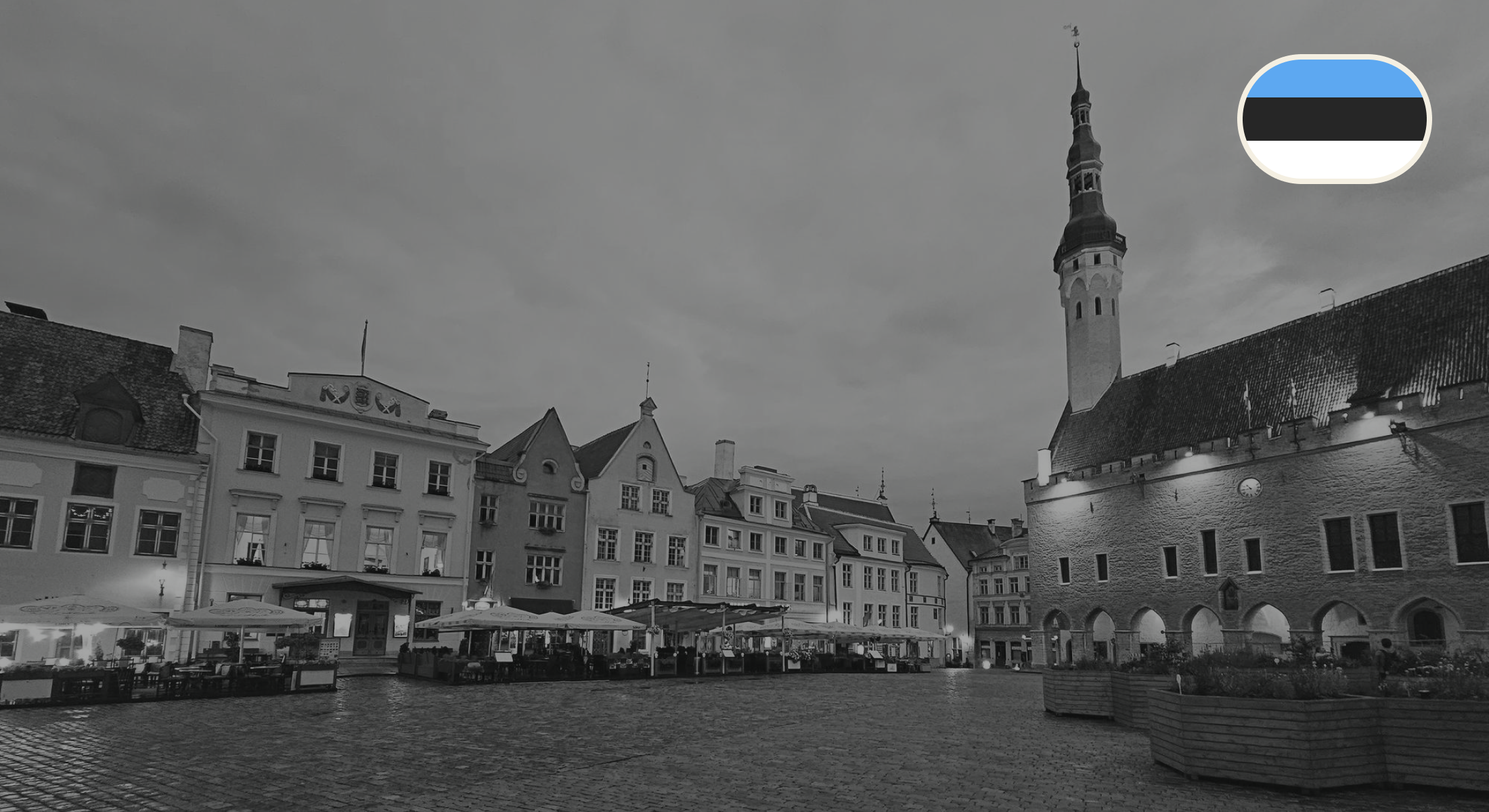


Estonia is known as one of the most digitally advanced countries, making it a popular choice for global companies seeking tech-savvy remote employees.
This guide covers what employers need to know about hiring in Estonia, including employment laws, payroll, taxes, and employee benefits, in order to build a compliant team in one of Europe's true hidden gems.
Can You Hire Remote Employees in Estonia?
Yes. Foreign companies can hire employees in Estonia, but they must comply with local employment laws covering contracts, payroll taxes, statutory benefits, working hours, and termination. Companies typically hire Estonian workers by establishing a legal entity in Estonia, or through an Employer of Record (EOR).
Why Companies Hire in Estonia
Estonia's investment in digital infrastructure began immediately after the country won its independence in 1991, and today — with its nationwide free Wi-Fi and near-universal broadband access — it produces a disproportionate number of tech unicorns for its size. Plus, its capital, Tallinn, is a startup hub — home to accelerators, venture capital firms, and a network of engineering talent.
Nearly every function of Estonia’s government, from company registration to tax filing, happens online. The country is built around a secure digital data-exchange layer known as X-Road, which connects public and private information systems, enabling 99% of Estonia's public services to be accessible online 24/7.
This level of digitization touches everyday business operations, too. Businesses can register a new company from anywhere in the world, and Estonia pioneered the e-Residency program, which has drawn people from more than 165 countries to become e-residents and establish thousands of companies — all without ever even setting foot in the country.
Companies hiring in Estonia also benefit from:
- Educated workforce: Estonia has a well-funded public education system with a strong emphasis on STEM fields.
- High English proficiency: Most professionals, especially in tech and business services, work comfortably in English.
- Business-friendly culture: Estonian workplaces tend to have flat organizational structures, direct communication styles, and extensive experience working with international companies.
- Remote work adoption: Remote work is well established in Estonia, giving employers access to professionals experienced working with distributed teams.
Country Snapshot
- Language: Estonian
- Currency: Euro (EUR)
- Capital City: Tallinn
- Population: Approximately 1.4 million
Estonia's Technology Sector
The country boasts a strong tech and AI workforce, supported by a startup ecosystem that has produced multiple billion-dollar companies, including Bolt, Wise, and Skype.
Because Estonians grow up using online banking, digital ID cards, and internet voting, they’re very comfortable with remote collaboration tools, cloud-based systems, and distributed work.
International employers commonly hire Estonian professionals for remote roles including:
- Software Engineers
- Full-Stack Developers
- Product Managers
- UX/UI Designers
- Data Analysts
- Cybersecurity Specialists
- Digital Marketers
- Customer Success Managers
- Finance and Accounting Professionals
- Project Managers
Estonian professionals are known for their pragmatism, strong problem-solving abilities, and ability to work independently, making them well suited to asynchronous, distributed teams.
Employment Laws: Hiring Compliantly in Estonia
Employment Contracts
Estonian employment relationships are governed by the Employment Contracts Act, which outlines mandatory employee protections.
The most common employment contracts are indefinite-term, which are used for ongoing, permanent roles.
While fixed-term contracts are permitted, they’re allowed only for a justified reason, such as seasonal work, a temporary increase in workload, or covering for an absent employee. A fixed-term contract signed without a valid reason is legally treated as if it’s an indefinite-term contract.
Employment contracts must be in writing. Although official filings are generally made in Estonian, it's common for employment contracts to be drafted in English or in both English and Estonian.
Working Hours and Pay
The standard workweek in Estonia is 40 hours, typically spread across 5 eight-hour days. Overtime requires agreement from both the employer and employee and must either be paid at 1.5 times the employee's regular rate or compensated with equivalent time off.
Employees are also entitled to daily and weekly rest periods, including at least 11 consecutive hours of rest in any 24-hour period.
As of April 1, 2026, Estonia's national minimum wage is EUR 946 per month and EUR 5.67 per hour for full-time work.
Remote and flexible work arrangements are common in Estonia and generally left to the discretion of the employer and employee, with no specific statutory restrictions on remote work beyond standard working-time and rest rules.
Probation Periods
Estonian law allows a probationary period of up to four months, which must be explicitly stated in the employment contract. For fixed-term contracts, probation can’t exceed the four-month cap or 50% of the total length of the contract, whichever is shorter.
During the probation period, either party can end the employment relationship by giving 15 days' notice. Employees still have the same legal protections during probation, including protection from discrimination. If the employee remains on after the probation period ends, the employment continues as a permanent position; no additional paperwork is required.
Employer Taxes
Employer payroll costs in Estonia are relatively straightforward compared with many European markets; however, they’re not capped, which is an important budgeting consideration. Estonian employer taxes include the following:
- Social tax: Employers pay a flat 33% tax on gross salary, which funds public pension insurance and state health insurance.
- Unemployment insurance: Employers contribute 0.8% of gross salary toward unemployment insurance.
- Minimum social tax base: Employers must pay social tax on a minimum monthly base of EUR 886, resulting in a minimum monthly social tax contribution of EUR 292.38 in 2026.
- Employee-side withholding: Employers are responsible for withholding and remitting employee income tax and social contributions through payroll.
Payroll taxes and social contributions are due by the 10th of the month.
There’s no mandatory 13th-month salary in Estonia, but performance bonuses are common.
Termination Process and Notice Requirements
There’s no at-will employment in Estonia. Employers must have a legally valid reason to terminate an employee, such as redundancy, misconduct, or the employee's inability to perform their job, and must provide written notice explaining the reason for termination.
The required notice period depends on the employee's length of service:
- Less than 1 year: 15 days
- 1-5 years: 30 days
- 5-10 years: 60 days
- 10+ years: 90 days for ten or more years
Employees may resign at any time by providing 30 calendar days' notice, or 15 days' notice during the probation period.
If an employee is laid off due to redundancy, the employer must pay at least one month's salary in severance pay. Employees with five to 10 years of service receive an additional month's salary, while those with more than 10 years of service receive two additional months' salary.
Collective redundancy rules and consultation obligations with Estonia's Unemployment Insurance Fund apply when a company terminates a specified number of employees within a 30-day period.
Certain categories of employees, including pregnant employees and those raising a child under the age of three, receive additional protection from redundancy-based termination.
Paid Leave Laws in Estonia
Vacation and Public Holidays
Employees in Estonia are entitled to a minimum of 28 days of paid annual leave, with certain categories of employees — including minors and those with reduced work capacity — entitled to 35 days. Unused leave can carry over, and employees are usually paid for any unused vacation upon termination of employment.
In addition to annual leave, there are 12 paid public holidays, including New Year's Day, Victory Day, and Independence Restoration Day.
Sick Leave
Responsibility for sick leave is shared between employers and the state. Employers cover the initial portion of an employee's sick leave before the Estonian Health Insurance Fund takes over. Benefits are generally paid at 70% of the employee's average earnings for up to 182 calendar days per illness.
Maternity Leave
Pregnant employees are entitled to up to 100 days of paid maternity leave, funded by the Estonian Health Insurance Fund and paid at 100% of their average earnings.
Paternity Leave
Fathers and equivalent second parents are entitled to 30 calendar days of paid paternity leave, also funded by Estonia's national insurance system.
Parental Leave
After maternity and paternity leave, parents can share up to 475 days of paid parental leave, which can generally be used until the child turns three.
Why Estonia Appeals to Remote Professionals
Estonia has become a popular base for remote professionals, freelancers, and digital entrepreneurs. For employers, that means you may encounter candidates who have chosen to live in Estonia while working remotely for companies elsewhere.
Some of the reasons professionals choose Estonia include:
- Reliable digital infrastructure, including near-universal broadband and widespread public Wi-Fi
- A high quality of life, with walkable cities, low crime, easy access to nature, and a strong social safety net
- A thriving startup ecosystem in Tallinn, offering networking opportunities and a strong technology community
- Easy travel throughout Europe thanks to Estonia's EU and Schengen membership
Estonia also offers a dedicated Digital Nomad Visa, which allows eligible employees and independent contractors working for organizations outside Estonia to live in the country and work remotely for up to 1 year.
If you hire someone in Estonia as an independent contractor, make sure the arrangement truly reflects an independent contractor relationship. If the worker is essentially treated like an employee, they could be legally classified as one under Estonian law.
How to Pay Remote Workers in Estonia
Paying employees in Estonia involves more than simply sending a salary. Employers must calculate payroll taxes, withhold employee taxes, and meet monthly reporting requirements.
Companies have several options for doing so, each with its own advantages and tradeoffs.
- International bank transfers are straightforward and widely supported, but they can be slow and carry high fees for cross-border payments.
- Wise offers competitive exchange rates and lower fees than traditional banks, but it isn't designed to handle payroll tax withholding.
- Payoneer makes it easy to pay contractors or smaller teams quickly, but it doesn't manage statutory tax withholdings.
- Global payroll providers can simplify multi-country payroll and offer broad international coverage, but employers still need a legal way to employ workers in Estonia.
- Local payroll providers have deep expertise in Estonian tax and employment laws, but this option generally requires employers to establish a local entity first.
Because of this complexity, many companies opt to partner with an Employer of Record (EOR), which allows them to pay and manage Estonian employees compliantly without setting up a local entity in the country.
FAQs
Can a foreign company hire employees in Estonia?
Yes. Foreign companies can hire employees in Estonia, but they must comply with local employment laws covering employment contracts, payroll taxes, statutory benefits, working hours, and termination. Companies can either establish a local legal entity or hire through an Employer of Record (EOR), which acts as the legal employer on the company's behalf.
Do I need a legal entity to hire employees in Estonia?
No. While companies can establish a local entity, many choose to work with an Employer of Record instead. An EOR enables businesses to hire employees in Estonia without incorporating locally while managing payroll, employment contracts, statutory benefits, and compliance with Estonian employment laws.
What employee benefits are required in Estonia?
Employers must provide several statutory benefits, including at least 28 days of paid annual leave, paid public holidays, sick leave, maternity, paternity, and parental leave, as well as mandatory employer social contributions and unemployment insurance.
Can I hire an independent contractor in Estonia instead of an employee?
Yes, but the working relationship must genuinely meet the legal criteria for independent contractor status. If a contractor is treated in practice as an employee, Estonian authorities may determine that an employment relationship exists, potentially exposing the employer to tax, payroll, and employment law obligations.
What is the easiest way to hire employees in Estonia?
For companies that don't plan to establish a local entity, partnering with an Employer of Record is often the simplest option. An EOR can hire employees on your behalf while handling employment contracts, payroll, taxes, statutory benefits, and ongoing compliance with Estonian employment laws.
Hire in Estonia With RemoFirst
As an EOR, RemoFirst helps companies hire employees (or contractors) in Estonia without the time, cost, or complexity of establishing a local entity.
RemoFirst acts as the legal employer of your Estonian team members, while you continue to manage their day-to-day work.
We handle employment contracts, payroll, statutory benefits, tax filings, and ongoing compliance with Estonian employment laws, helping you hire without opening a local entity.
Schedule a demo to learn how RemoFirst can simplify hiring, paying, and managing employees and contractors in Estonia.