If it feels like everyone is talking about Employer of Record (EOR) services right now, well, it's because they kind of are.
What started as a niche solution for companies testing international markets has become one of the fastest-growing segments in HR and workforce management. And according to multiple industry reports, that growth isn't slowing down anytime soon.
The question isn't whether global hiring will continue. The question is how companies will keep up.
The Data Behind the Growth
The EOR market is no longer a niche category. According to research from The IEC Group, the market is projected to grow from $6.9 billion in 2025 to $12 billion by 2030 as companies increasingly rely on global hiring to access talent and expand into new markets.
The growth isn't being driven by a single trend. Instead, several forces are converging at once:
- Companies are hiring globally earlier in their growth journeys.
- Remote and distributed work have become standard operating models.
- Talent shortages continue to push employers beyond local labor markets.
- Compliance requirements are becoming more complex across jurisdictions.
- Organizations want to avoid the cost and administrative burden of opening foreign entities.
Research from NelsonHall also shows that small and mid-sized businesses account for the majority of EOR adoption today (~85%), largely because they need access to global talent without building large legal, HR, and payroll teams in every country where they hire.
What Industry Analysts Are Predicting
The next phase of EOR growth won't just be about hiring employees in more countries.
Analysts expect the market to evolve in several important ways:
EORs Become Strategic Growth Infrastructure
Historically, many companies viewed EORs as a short-term solution for testing new markets or making a handful of international hires.
That's changing.
Industry analysts note that EOR providers are expanding beyond traditional payroll and compliance services to support broader workforce operations, including recruiting, contractor management, mobility services, and global expansion planning.
In practice, that means companies are increasingly using EORs as part of their long-term hiring strategy rather than as a temporary workaround.
AI Will Change How Global Hiring Operates
AI is already influencing product development across the EOR market.
Providers are investing heavily in automation, compliance monitoring, onboarding workflows, payroll operations, and employee support tools. The goal is simple: make global employment faster and less complex for both employers and employees.
Demand Will Shift Toward Specialized Talent Markets
The competition for talent isn't getting easier.
As organizations race to build AI products, strengthen cybersecurity defenses, and scale technical teams, many are finding that the talent they need isn't located in their home country.
Global hiring opens access to specialized talent pools across Eastern Europe, Latin America, Africa, Southeast Asia, and beyond. EORs provide a compliant way to access those markets without waiting months to establish local entities.
What This Means for Employers
The biggest takeaway is that global hiring is becoming a competitive advantage.
Five years ago, hiring internationally was often considered an enterprise strategy.
Today, startups and mid-market companies are using global hiring to compete with much larger organizations. They can recruit from a worldwide talent pool, enter new markets faster, and build distributed teams without significant upfront investment.
Companies that limit hiring to a single geography may increasingly find themselves competing for a shrinking share of in-demand talent.
This is especially true for roles in:
- Artificial intelligence and machine learning
- Cybersecurity
- Software engineering
- Data science
- Cloud infrastructure
- Product management
There's also growing evidence that global hiring can actually speed up recruiting timelines.
According to our recent survey data, 51% of companies said international roles are filled faster than roles based at headquarters.
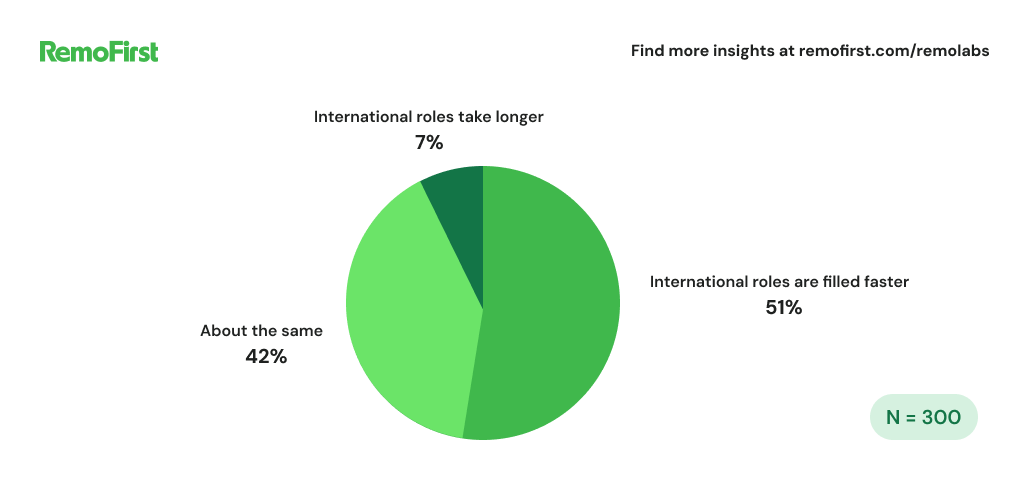
That challenges the long-standing assumption that cross-border hiring is inherently slower or more complicated. For fast-moving teams hiring in areas like AI, cybersecurity, and engineering, that hiring speed can become a major competitive advantage.
The talent exists. The challenge is accessing it compliantly and efficiently.
Our Take
The growth of the EOR market is really a reflection of something much bigger: the globalization of talent.
The best candidate for a role is no longer necessarily the person who lives within commuting distance of your office. More often, they're located somewhere else entirely.
As skills shortages continue and remote work remains mainstream, we expect global hiring to become a standard part of workforce strategy rather than a specialized initiative.
The companies that embrace this shift will have access to larger talent pools, greater hiring flexibility, and faster expansion opportunities.
Those that don't may find themselves competing for the same limited talent while their competitors recruit from the entire world.
By 2028, the EOR market will likely look very different than it does today. But one thing seems clear: global hiring isn't a trend. It's becoming the new normal.